
Source [De]Coded — Two-thirds of journalists are waiting for your pitch. No pressure.

Author
Greg Mondshein & Becky Honeyman
05.21.2026


See how we tackle today’s biggest PR and marketing challenges.
 Building brand awarenessChanging brand perceptionCreating a new categoryDeveloping a brand strategyEnter new marketsGaining market shareGenerating leadsLaunching a new offeringMeasuring a comms programReddit strategy & community amplificationRepositioning a brandAI Visibility & Search Discovery (AEO/GEO)
Discover the industries we serve – and why we’re so passionate about them. From B2B SaaS to consumer health and wellness, we have the expertise to drive ROI for your PR and marketing spend.

Check out our comprehensive range of services and how we do things differently.
Awards Program & Speakers BureausBrand StrategyConsumer Reviews ProgramContent CreationContent & Coverage AmplificationCorporate CommunicationEarned Media & StorytellingExecutive VisibilityGlobal Campaign CoordinationIntegrated MarketingInfluencer RelationsMeasurement, Insights, & AnalyticsPublic AffairsSocial MediaStakeholder EngagementStrategy Counsel
It’s a simple equation: clear insights + deep expertise + creative thinking = remarkable results. Our client case studies prove it.

Learn how SourceCode is uniquely prepared to address your specific communications goals.

Greg Mondshein & Becky Honeyman
05.21.2026
Hey Team,
Planning season might be a marathon, but we are absolutely crushing it right now. We officially locked in Arccos, golf’s #1 game tracking platform as our newest agency of record, and today we are celebrating yet another massive addition to the family by announcing Breezy as our latest AOR win.
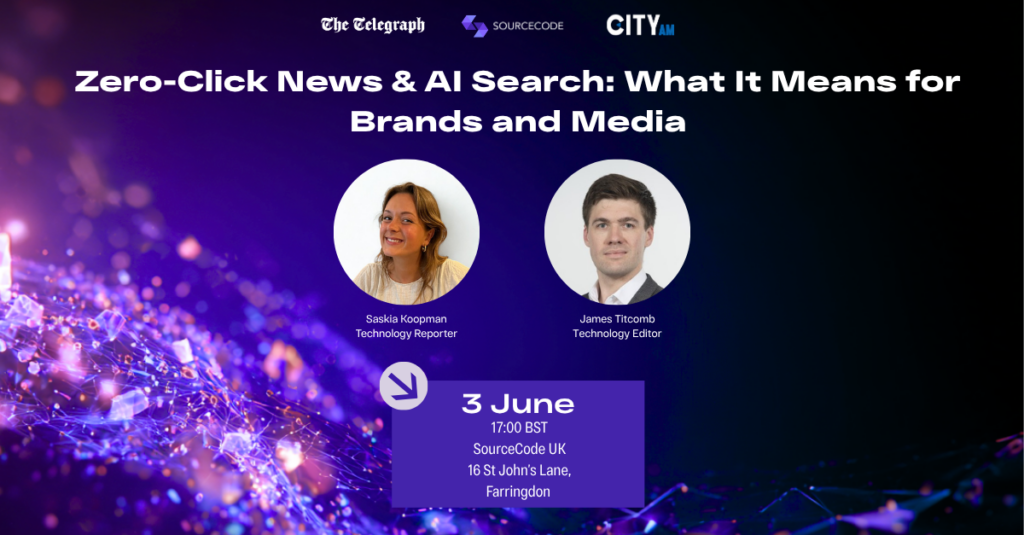
For those across the pond or looking for an excuse to fly over, Giles is hosting a panel session on June 3rd, titled Zero-Click News & AI Search: What It Means for Brands and Media. It features an elite lineup of reporters from City AM and The Telegraph, so make sure you lock in your spot.
Separately, all of this growth is happening against a backdrop where everyone is trying to figure out what value actually looks like anymore. The recent POSSIBLE 2026 conference made it incredibly obvious that AI is leveling the playing field on basic execution, a reality Christa just broke down in her latest blog post. It is a world where reach and production capacity are no longer a defensible advantage because anyone with a prompt can create output. The brands and agencies winning right now are the ones that realize AI hasn’t replaced agency value, it has just called the bluff on empty scale and forced us to finally explain what that human strategy is actually worth.
This shift toward genuine strategy and navigating the AI shift is exactly what separates the brands that stick from the ones just lighting money on fire to feel productive. Let’s dig into what is shaking up the industry this week, starting with why AI is forcing a total rewrite of how we define our worth.
Let’s get into it.
Becky and Greg
SourceCode’s latest data deep dive cuts through the market panic to look at what is actually happening to organic discovery in 2026.
TL;DR: While headlines scream that AI Overviews and chatbots are an extinction-level event for SEO, the reality is far more complex. Gartner’s prediction of a 25% drop in traditional search volume is clashing with actual market data: Graphite and Similarweb found organic traffic across the top 40,000 US websites dropped just 2.5% year-over-year. The truth is that the search pie is expanding rather than shrinking—total search usage across traditional and AI platforms has actually increased by 26% globally since ChatGPT launched.
Takeaway: The AI search conversation has been flooded by vendor hype designed to make marketers feel permanently behind. The real story isn’t that search is dying; it’s that it is fragmenting and shifting toward informational queries. Mid-sized sites are taking single-digit hits, while commerce and marketplaces are actually growing. When total query volume goes up but user behavior shifts toward zero-click summaries, the solution isn’t to dump your SEO budget into an unproven “AI optimization” tool. The fix is systemic: communications, content, and search can no longer operate as separate fiefdoms. Winning requires a unified strategy that optimizes for how real people navigate this new ecosystem, not how algorithms panic-react to it.
Consider:
The POSSIBLE 2026 conference surfaced a real strategic tension: AI is levelling the playing field on execution, so differentiation now lives somewhere harder to fake.
TL;DR:
Harmelin’s roundup of POSSIBLE 2026 highlights how AI is fundamentally shifting the agency value proposition — compressing timelines, enabling smaller players to compete on outcomes, and pushing the industry toward a results-first model. The conference consensus: reach is no longer a defensible advantage, and neither is production capacity.
Takeaway:
When AI makes execution table stakes, the question every agency and brand team has to answer is: what do we actually sell? For too long, scale and speed were proxies for competence — AI has just called the bluff. The marketers who will win aren’t those with the most tools; they’re the ones who can still articulate a clear point of view on what good looks like and why it matters. This is less a technology story than a strategy story wearing a technology costume.
Consider:
New research from Talon.One makes the case that creative promotions — not price cuts — are what actually build long-term loyalty and protect margin.
TL;DR:
Presented at VML’s Growth Summit in Amsterdam, Talon.One’s research identifies eight “creative currencies” — including exclusivity, experience, and personalisation — that brands can use instead of defaulting to discounts. The argument is straightforward: discounting trains customers to wait for sales, erodes perceived value, and is extraordinarily hard to walk back once it becomes expected.
Takeaway:
The discount death spiral is well-documented, and yet brands keep entering it — usually because discounting is fast, measurable, and easy to defend in a quarterly review. What this research offers is not a new idea so much as a structured vocabulary for the harder conversation: how do you make customers feel rewarded without teaching them that your product isn’t worth full price? The answer almost always involves creativity and specificity, which require more investment upfront and pay off on a timeline that doesn’t always fit the reporting cycle. That’s the real obstacle, not the lack of alternatives.
Consider:
Cision’s 2026 State of the Media Report finds two-thirds of journalists now rely on PR as a primary source, a number that should prompt serious reflection across the industry.
TL;DR:
Cision’s 2026 State of the Media Report reveals that 66% of journalists now cite PR as a primary source for story ideas — a figure that reflects the structural pressures on modern newsrooms, including reduced headcount, compressed deadlines, and the growing volume of AI-generated content competing for attention. PR has quietly become load-bearing infrastructure for journalism.
Takeaway:
This data is genuinely significant, but it cuts both ways. Yes, PR has more influence in the story pipeline than it has had in decades — that is not a small thing. But influence without credibility is short-lived, and the implication of this finding is that the communications industry now carries a real responsibility for the quality and integrity of what it puts in front of journalists. The brands and agencies that treat this as leverage to push product narratives harder will eventually find the door closed. The ones who treat it as a mandate to provide genuinely useful, accurate, and relevant information will build durable media relationships that hold up even when the news cycle isn’t in their favour.
Consider: