
AI Search is Multilingual. Is Your AEO Strategy Keeping Up?

Author
Ségolène Roche
Leadership
10.21.2026


See how we tackle today’s biggest PR and marketing challenges.
 Building brand awarenessChanging brand perceptionCreating a new categoryDeveloping a brand strategyEnter new marketsGaining market shareGenerating leadsLaunching a new offeringMeasuring a comms programReddit strategy & community amplificationRepositioning a brandAI Visibility & Search Discovery (AEO/GEO)

Discover the industries we serve – and why we’re so passionate about them. From B2B SaaS to consumer health and wellness, we have the expertise to drive ROI for your PR and marketing spend.

Check out our comprehensive range of services and how we do things differently.
Awards Program & Speakers BureausBrand StrategyConsumer Reviews ProgramContent CreationContent & Coverage AmplificationCorporate CommunicationEarned Media & StorytellingExecutive VisibilityGlobal Campaign CoordinationIntegrated MarketingInfluencer RelationsMeasurement, Insights, & AnalyticsPublic AffairsSocial MediaStakeholder EngagementStrategy Counsel
It’s a simple equation: clear insights + deep expertise + creative thinking = remarkable results. Our client case studies prove it.

Learn how SourceCode is uniquely prepared to address your specific communications goals.

Ségolène Roche
10.21.2026
Marketers have long understood the importance of multilingual content for reaching local audiences. With AI algorithms now brands’ first audience, it’s vital to ensure your Answer Engine Optimization (AEO) strategy performs in all relevant languages.
Have a look at these AI search prompts.
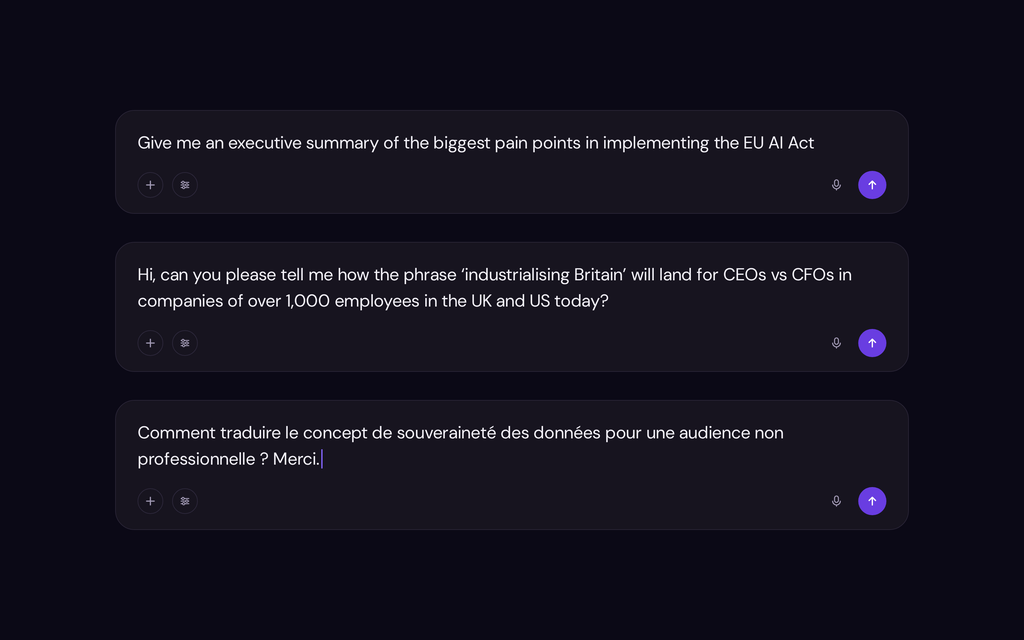
I bet you have created a mental image of the person writing the prompt (gender, seniority level, level of proficiency with AI tools). So did your LLM of choice.
LLMs use contextual cues to respond to questions. And that includes language and tone. There is extensive research on ways to ask good prompts, but analysis of the way various LLMs respond to prompts in different languages is a lot more limited.
Prompt politeness has been proven to affect data accuracy, with less polite prompts yielding more accurate responses from LLMs. Meanwhile, Oxford University research shows that open models come with inherent biases based on gender, ethnicity, age and socio-economic status.
Taking it one step further, experiments on Reddit show that politically charged prompts give radically different answers depending on the limitations put on the model in each language. More rigorous academic research has also shown that LLMs deliver a broader and more accurate range of insights in rich-resource languages (like English) than low-resource languages (like Swahili), further increasing existing biases and disparate access to information.
“Knowing your audience doesn’t only mean knowing who your buyers’ job titles are.” Place after the second paragraph under “Why should marketing AI strategies be multilingual?”
This situation is adding a level of complexity that multilingual, multi-audience marcomms leaders are already familiar with: the need for nuanced, culturally relevant communications. But this time, through an AI lens.
Knowing your audience doesn’t only mean knowing who your buyers’ job titles are. You need to understand all the sub-context that shapes who they are as people and how they make decisions. Language is one of these parameters, which is why any global marcomms strategy should involve a multilingual approach.
Most established businesses already consider multilingual output for their corporate website, social media and even in their spokespeople bench. What they are not yet doing extensively is extending this approach to LLMs and their AEO strategy.
In many ways, competition for visibility is harder in rich-resource languages such as English, French, German or Spanish, which is why being both relevant and having a unique voice is so crucial in those markets. This requires having strong opinions backed by data and examples; having a consistent exec brand platform across channels that gives your spokespeople genuine market leadership; and working with local media and content creators to amplify those stories in the channels that your audience (both human and machine) engage with.

Low-resource languages provide a unique opportunity for companies to immediately stand out. For example, Hindi is a low-resource language, despite being the world’s third most widely spoken language with around 600 million speakers. This means LLMs being asked questions in Hindi will surface limited content in Hindi, and end up looking for insights in English and other rich-resource languages. For any brand trying to stand out in the Indian market, this is a huge opportunity to become the de facto source of Hindi-language insights for LLMs while also continuing to build a global presence.
“Low-resource languages provide a unique opportunity for companies to immediately stand out.”
This will affect how you show up in answer engines as LLMs continue to be trained on a broader range of multilingual sources. Combining your global strategy in English and rich-resource languages with genuine, local market and low-resource language expertise means you have much better control over your brand positioning around the world, no matter what language your audiences speak, and what prompts they use to make decisions.
So when you are thinking of your AEO strategy, always remember to check that you’re not only looking at your visibility in English, but also auditing how well you’re performing in all your target languages.
Yes. Academic research shows large language models give a broader and more accurate range of insights in rich-resource languages like English than in low-resource languages like Swahili. Tone and politeness in a prompt can also change the answer.
It is a language with relatively little content for AI models to draw on, even if millions of people speak it. Hindi is one example, despite having around 600 million speakers.
Language shapes how buyers make decisions, and AI assistants respond differently depending on the language they are asked in. Most brands already publish in several languages on their website and social channels but have not yet applied the same thinking to how they show up in AI answers.
Audit how your brand performs in AI answers in every language your audiences use, not only English. Compare results across languages to see where your positioning holds up and where it disappears.