
I’m not a robot. But why do I feel I need to prove it?

Author
Lara Genser
Leadership
09.16.2026


See how we tackle today’s biggest PR and marketing challenges.
 Building brand awarenessChanging brand perceptionCreating a new categoryDeveloping a brand strategyEnter new marketsGaining market shareGenerating leadsLaunching a new offeringMeasuring a comms programReddit strategy & community amplificationRepositioning a brandAI Visibility & Search Discovery (AEO/GEO)
Discover the industries we serve – and why we’re so passionate about them. From B2B SaaS to consumer health and wellness, we have the expertise to drive ROI for your PR and marketing spend.

Check out our comprehensive range of services and how we do things differently.
Awards Program & Speakers BureausBrand StrategyConsumer Reviews ProgramContent CreationContent & Coverage AmplificationCorporate CommunicationEarned Media & StorytellingExecutive VisibilityGlobal Campaign CoordinationIntegrated MarketingInfluencer RelationsMeasurement, Insights, & AnalyticsPublic AffairsSocial MediaStakeholder EngagementStrategy Counsel
It’s a simple equation: clear insights + deep expertise + creative thinking = remarkable results. Our client case studies prove it.

Learn how SourceCode is uniquely prepared to address your specific communications goals.

Lara Genser
09.16.2026
I am a human. I really am. And I am writing this, not an AI. I might use an em dash, I might not (I haven’t got that far yet). I might even claim that something isn’t “X”, it’s “Y.” But I am, honestly, a real-life human being.
It’s a strange world we occupy. More and more, people are having to convince other people that they’re human, and that their work is a result of their real honest labor.
Writing blogs is a case in point. Where AI provides perfectly polished and grammatically correct prose, many people are leaning into more idiosyncratic writing. By making their work rough around the edges, or full of anecdotes, colloquialisms, and even typos, they aim to show that it’s been written by a real person.
Proving that we’re human is only part of the battle. Increasingly, people are wondering what that actually means. If AI can do things as well as, or better than humans, what value do we really have? We find ourselves trying to convince each other that humans still have value.
It’s all a bit silly really, to think we’re now finding ways to justify why human creativity, oversight, judgement, and experience matters.
This isn’t the first time humans have questioned their relevance. When the Industrial Revolution hit, artisans had to justify why their craft was superior to machine-made goods. When cameras came along, portrait painters had to make the case for their art and the deeper truths it can reveal about the subject.
But AI feels different. Maybe because for the first time intelligence is being challenged. Maybe it’s the scale of change. AI touches nearly everything. It’s becoming harder to know what’s real, and to justify why it matters anyway. Or maybe it’s just the pace of change and the speed at which agents can outpace you. The Industrial Revolution played out over a century. AI, in this form—generative, agentic and suddenly accessible to almost everyone—has only really been around a couple of years, and it’s already transforming the world.

We find ourselves trying to convince each other that humans still have value.
I’m not a technologist. I’ve built my career around people—serving clients, building connections, creating community and telling stories.
That is why I welcome AI when it takes tedious work off our plates, but worry when the conversation begins and ends with productivity. What matters is what we do with the time it gives back: more thoughtful work, stronger relationships and better ideas—or simply more output from people reduced to prompters, checkers and approvers?
In communications, the value is rarely in producing more words, more ideas or more output. It is in understanding what a client is really trying to solve. It is in finding the human truth in a story. It is in knowing when a message will land badly, when an idea needs more work, or when the smartest thing to do is pause and listen.
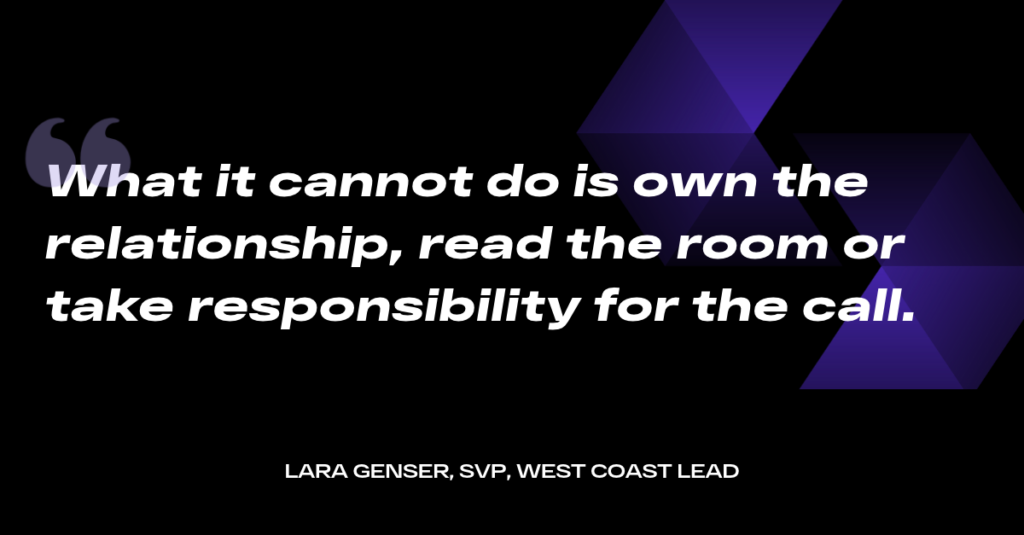
It is in building enough trust with a client, journalist, creator or colleague that they tell you what they actually think. AI can help us get to a first draft faster, organize information and remove administrative drag. What it cannot do is own the relationship, read the room or take responsibility for the call.

That is where leaders have an important role to play. In all this wonderful messiness, we need to be intentional about the kind of work, teams and culture we are building around AI tools.
We should help people become fluent in using AI: curious about it, appropriately skeptical of it and confident enough to challenge its output. But we also need to protect and develop the capabilities that make people valuable in the first place— the art behind the content, the empathy, judgement, critical thinking, and the ability to bring different perspectives together.
We still need to deliver outcomes, of course. But we should be careful not to measure work only by speed, volume and cost.
Some of the most valuable parts of a team’s work are harder to quantify: the conversation that changes the brief, the debate that sharpens an idea, the relationship that makes a client comfortable telling you the truth, or the instinct to stop something from going out because it is technically fine but emotionally wrong.
It’s understanding that work is more than how many words of copy you write, how many budgets you balance, or how many slides you design – it’s every bit as much about building human connections and identifying ways we can support each other.
And that’s where AI can help. Because of course there are loads of boring, manual tasks it can take off our hands. In doing so, it can help us be more human.
What it cannot do is own the relationship, read the room or take responsibility for the call.
As AI produces polished, grammatically perfect prose, more writers are leaning into rougher, more idiosyncratic writing on purpose, anecdotes, colloquialisms, even typos, as a signal that a real person wrote it.
AI can speed up a first draft and clear administrative work, but it can’t own the relationship, read the room, or take responsibility for the call. That judgment stays with the person.
Not on its own. The value is in what the time saved gets used for, more thoughtful work and stronger relationships, not just more output from people reduced to prompting and checking.
Help people get fluent and appropriately skeptical of AI, while protecting the harder-to-measure skills that make people valuable: judgment, empathy, critical thinking, and the instinct to stop something that’s technically fine but emotionally wrong.
Not only by speed, volume, and cost. Some of the most valuable work, the conversation that changes a brief, the relationship that earns real honesty from a client, is hard to quantify but shouldn’t be discounted.