
Source [De]Coded — The End of the Duopoly and the Rise of AI Infrastructure

Author
Greg Mondshein & Becky Honeyman
05.07.2026


See how we tackle today’s biggest PR and marketing challenges.
 Building brand awarenessChanging brand perceptionCreating a new categoryDeveloping a brand strategyEnter new marketsGaining market shareGenerating leadsLaunching a new offeringMeasuring a comms programReddit strategy & community amplificationRepositioning a brandAI Visibility & Search Discovery (AEO/GEO)
Discover the industries we serve – and why we’re so passionate about them. From B2B SaaS to consumer health and wellness, we have the expertise to drive ROI for your PR and marketing spend.

Check out our comprehensive range of services and how we do things differently.
Awards Program & Speakers BureausBrand StrategyConsumer Reviews ProgramContent CreationContent & Coverage AmplificationCorporate CommunicationEarned Media & StorytellingExecutive VisibilityGlobal Campaign CoordinationIntegrated MarketingInfluencer RelationsMeasurement, Insights, & AnalyticsPublic AffairsSocial MediaStakeholder EngagementStrategy Counsel
It’s a simple equation: clear insights + deep expertise + creative thinking = remarkable results. Our client case studies prove it.

Learn how SourceCode is uniquely prepared to address your specific communications goals.

Greg Mondshein & Becky Honeyman
05.07.2026
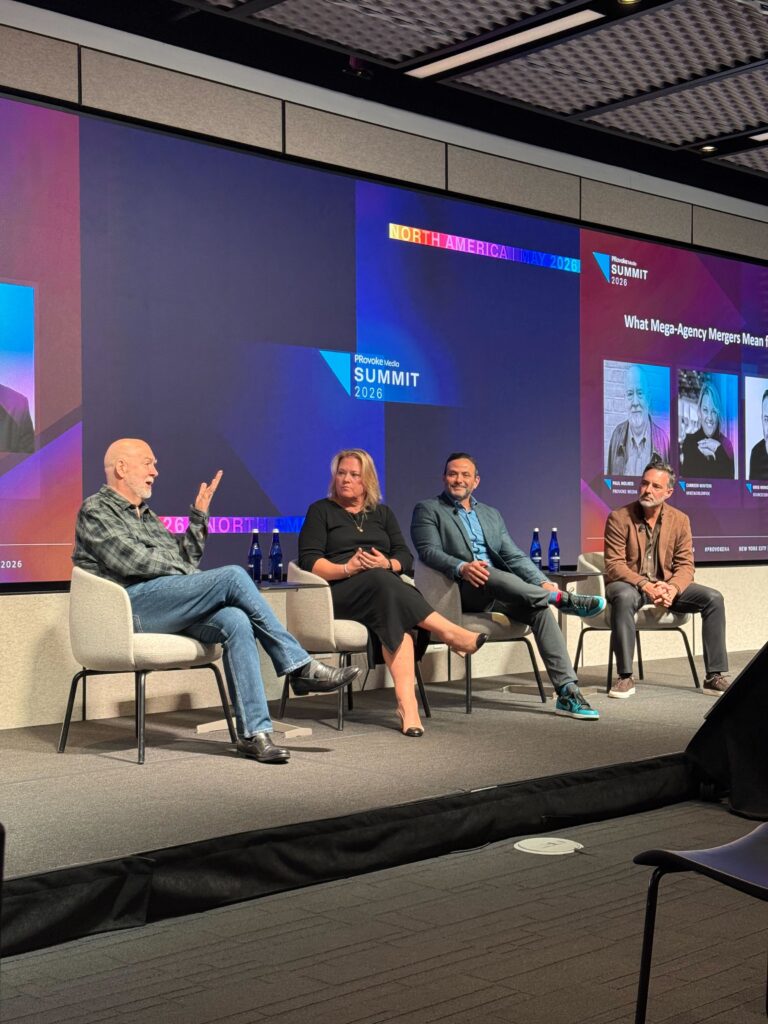
Hey team! We are hitting our stride this May and the wins just keep on coming. Christa and I were out there soaking up the sun and insights at POSSible Miami, and I had the chance to take the stage at the PRovoke North America Summit to talk about where independent agencies are headed next. To top it all off, our friends at Airalo just snagged a Communicator Award for some seriously top-tier brand storytelling. We are basically the marketing equivalent of a championship winning streak right now, and if we get any more accolades, I might start demanding a specialized trophy room in the office.


This week we are diving into a major power shift because for the first time ever, Meta has officially managed to dethrone Google in the global ad revenue race. The old search giant isn’t dead, but the crown is definitely feeling a bit heavy. It turns out that while Google owns the moment you know what you want, Meta is winning the battle for everything you didn’t even know you needed yet.
It is a massive signal that the market is rewarding discovery over just plain intent. If your strategy is still living in 2024, you are essentially trying to navigate a new city with a map from the nineties. Let’s get into why the digital ad map just got a total makeover.
Let’s get into it.
Becky and Greg
Sovereign cloud, the EU AI Act, and a skills crisis are reshaping what resonates with B2B audiences across the UK and Europe.
TL;DR: Giles Peddy identifies three forces currently driving tech buying decisions across Europe: rapid investment in sovereign cloud infrastructure (forecast to triple by 2027), the rise of agentic AI as a response to chronic skills shortages, and the EU AI Act’s August mandate for human oversight of high-risk systems. The thread connecting all three is localisation. Brands that reflect regional regulatory and cultural context in their messaging drive measurably better pipeline outcomes.
Takeaway: This is a practical reminder that global reach and local relevance are not the same thing. European tech buyers are navigating a regulatory environment, a talent market, and a geopolitical context that simply does not map onto the US playbook. The data bears this out: 96% of B2B leaders report positive ROI from localisation, and the cost of ignoring it can run to 20% of potential revenue. For comms and marketing teams supporting global tech brands, the three trends Giles outlines are not future considerations. They are live concerns in customer conversations right now, and the brands showing up with answers framed around European priorities are winning the trust that eventually converts.
Consider:
The duopoly did not die. It reshuffled.
TL;DR: For the first time in digital advertising history, Meta is projected to surpass Google in global ad revenue in 2026, reaching approximately $243 billion compared to Google’s $239 billion, according to eMarketer. Meta’s growth rate of 24 percent is more than double Google’s 12 percent, driven by Reels performance, Advantage+ AI automation, and first-party data strength.
Takeaway: This is not a symbolic milestone. It is a signal about what the market is rewarding. Meta built a platform that is easier to automate, easier to measure, and increasingly better at generating demand that buyers did not know they had. Reels is functioning as a discovery engine, not just a content format. Advantage+ is doing targeting work that used to require dedicated analysts.
The deeper shift is structural. Google still owns high-intent search, the moment when someone already knows what they want. But the mid-funnel, where brand awareness is built and consideration is shaped, is increasingly Meta’s territory. That creates a real strategic question for media allocation. If your budget is still heavily weighted toward search, you may be optimizing for conversion while surrendering the consideration stage to a competitor who got there first through a Meta feed.
The lesson is not to abandon search. It is to understand that the map has changed. Building brand memory now requires presence in places that feel less immediately measurable but matter more in the long run.
Consider:
The AI ad gap is widening, and most brands are not looking at it.
TL;DR: New IAB research confirms that Gen Z and Millennial consumers feel significantly less positive about AI-generated advertising than ad executives believe. Seventy-two percent of Gen Z hold negative or cautious views of AI-generated content. Meanwhile, 64 percent of advertisers now cite cost efficiency as the top benefit of AI in ad production, up from fifth place in 2024. Gen Z is more likely to describe brands using AI ads as inauthentic or fake, while advertisers are increasingly focused on production savings. Disclosure helps: when brands are transparent about AI use, purchase likelihood increases.
Takeaway: This is the tension that most marketing conversations are refusing to sit with. AI tools are becoming the default production layer because they reduce cost and increase speed. But the audience most brands are chasing has become remarkably good at detecting what feels manufactured, and they associate that feeling with inauthenticity, which is the one thing Gen Z does not forgive.
The strategic trap is measurement. Cost efficiency is easy to quantify. Brand perception erosion is much harder to see on a dashboard until it has already done significant damage. The brands winning with Gen Z are not the ones using AI least. They are the ones using AI transparently, as a tool that accelerates human creativity rather than replaces it, and being honest about that distinction when it matters to the audience.
This is also an opportunity for PR and communications teams. Human voice, human point of view, and credible real-world expertise are differentiators in a feed that is increasingly machine-generated. That is a story worth telling more deliberately.
Consider:
Walmart, Coca-Cola, and PepsiCo are done experimenting. Now it gets operational.
TL;DR: At POSSIBLE 2026, marketing leaders from Walmart, Coca-Cola, The Home Depot, PepsiCo, and others shared how they have moved AI from experimentation into core operational infrastructure. Walmart reports that 73 percent of its marketing investment is now AI-enabled in some form, touching targeting, bidding, media placement, and dynamic creative. The Home Depot has instituted weekly Transformation Thursdays to map end-to-end workflows and identify AI integration opportunities. PepsiCo is moving away from linear launch models and toward flexibility across channels, messaging, and timing as the traditional marketing funnel dissolves.
Takeaway: The era of the AI pilot is ending. At Walmart, 73 percent of marketing investment is already AI-enabled in some form. That is not experimentation. That is infrastructure. And the companies sharing these numbers are not doing so to impress. They are doing so because the scale of what they have built is now producing results that justify the investment.
What is striking about the POSSIBLE conversations is what they are not saying. Nobody is presenting AI as the idea factory. The framing is consistently operational: faster iteration, smarter targeting, more flexible campaign structures that can respond to market conditions rather than plan around them. PepsiCo’s comment about the funnel no longer being linear is particularly telling. The implication is that sequential brand building is being replaced by continuous, adaptive presence.
For smaller brands and agencies, the lesson is not to match Walmart’s scale. It is to understand the underlying logic: AI advantage in marketing is now a workflow advantage, not a creative shortcut. The brands building durable capability are the ones mapping their processes and making deliberate decisions about where AI accelerates value, not just where it reduces headcount.
Consider: