

AAO: WTF is it, and what B2B Marketers Actually Need to Know

Author
Kevin Dulaney
Leadership
02.26.2026


See how we tackle today’s biggest PR and marketing challenges.

Discover the industries we serve – and why we’re so passionate about them. From B2B SaaS to consumer health and wellness, we have the expertise to drive ROI for your PR and marketing spend.

Check out our comprehensive range of services and how we do things differently.
 Awards Program & Speakers BureausBrand StrategyConsumer Reviews ProgramContent CreationContent & Coverage AmplificationCorporate CommunicationEarned Media & StorytellingExecutive VisibilityGlobal Campaign CoordinationIntegrated MarketingInfluencer RelationsMeasurement, Insights, & AnalyticsSocial MediaStakeholder EngagementStrategy Counsel
It’s a simple equation: clear insights + deep expertise + creative thinking = remarkable results. Our client case studies prove it.

Learn how SourceCode is uniquely prepared to address your specific communications goals.

Kevin Dulaney
02.26.2026
Let’s acknowledge the obvious, marketing loves a new acronym.
We had SEO, AEO and GEO. Now AAO is entering the group chat. If you’ve been in this industry long enough, your first reaction is probably, “Do we really need another one?”
Underneath the naming fatigue, something real is happening. The way buyers move from problem to solution is changing because AI is now embedded directly in the discovery layer. That doesn’t make SEO irrelevant. It expands the environment around it.
And if you work in B2B, ignoring that shift is not a strategy.
Search Engine Optimization was built for blue links. Rank higher, earn the click, move traffic through the funnel. It rewarded structure, backlinks, and keyword alignment. That still matters.
Answer Engine Optimization emerged when users stopped clicking ten links and started expecting direct answers. Featured snippets, voice responses, zero click summaries. Now you needed to be structured clearly enough to be extracted as the answer.
Around the same time, large language models started synthesizing information. Generative Engine Optimization became necessary because it wasn’t enough to rank. You also needed to be accurately represented inside AI generated comparisons.
Now we’re talking about Assistive Agent Optimization.
There are a few more, but here is the breakdown.
SEO helps you get discovered.
AEO helps you get quoted.
GEO helps you get described.
AAO helps you get selected.
That last one is where we are starting to see a shift.
The Transformation of B2B Procurement and Buyer Behavior
The shift toward AAO is validated by empirical changes in the B2B buying journey. Research from 2024 and 2025 indicates that enterprise technology buyers have moved away from traditional search as their exclusive starting point for research.
According to the “Press-to-Pipeline” report, 47% of enterprise technology buyers now initiate vendor research with AI assistants like ChatGPT and Google Gemini. This represents a significant displacement of Google Search, which has dropped to 43% as a primary starting point.
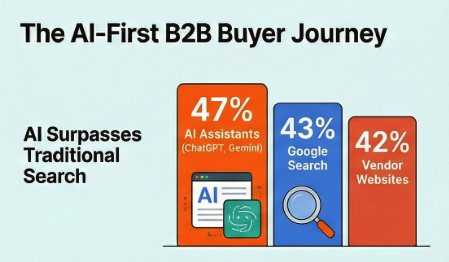
| Primary Research Tool (B2B Buyers) | Adoption Rate |
| AI Assistants (ChatGPT, Gemini, etc.) | 47% |
| Google Search | 43% |
| Vendor Websites | 42% |
| Trade Publications | 40% |
Furthermore, once buyers enter the evaluation phase, 93% utilize AI to summarize or compare vendors. This indicates that a brand’s “shortlist eligibility” is determined by its ability to be correctly interpreted and prioritized by these agents before a sales conversation ever occurs.
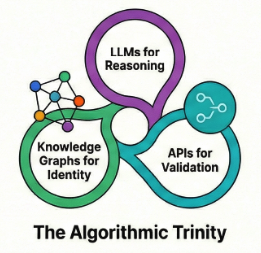
Assistive agents operate differently from traditional search engines. Instead of ranking pages, they reason across structured data, knowledge graphs, reviews, and third party signals before narrowing options.
This environment runs on what can be described as an algorithmic trinity: large language models for reasoning, knowledge graphs for entity resolution, and search APIs for validation.
In other words, agents are evaluating who you are before they decide whether you are worth recommending, and they are already active.
Procurement teams are experimenting with AI to summarize vendor landscapes. Enterprise copilots are drafting comparison tables before sales conversations begin. Marketing leaders are using generative tools to sense check options before booking demos.
The shortlist is being influenced earlier than most dashboards reflect.
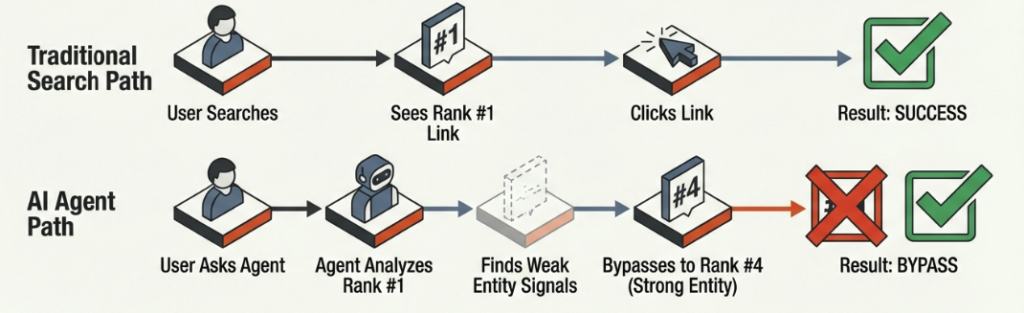
There’s a concept called agent bypass
It describes what happens when a brand ranks well in traditional search but gets skipped by an AI system because its entity signals are unclear or its authority footprint is weak.
That’s uncomfortable to think about. All the time spent on creating content, planning and strategy could be for nothing.
You can be visible and still not be credible in machine logic.
In early implementations, brands that strengthened structured authority signals saw measurable increases in AI surfaced recommendations.
That’s not vanity. That’s shortlist math.
All of this technology talk is interesting, but it distracts from something simpler.
Buyers have problems.
They are worried about regulatory exposure.
They need better data visibility.
They want to reduce operational risk.
They are not thinking about your keyword strategy.
If someone asks an AI assistant, “What is the most secure cloud infrastructure for a fintech company with compliance requirements?” the system cross references structured data, certifications, review sentiment, and authority signals before recommending a vendor.
If your brand consistently articulates that problem and reinforces its credibility across earned media, analyst coverage, reviews, and technical structure, you align naturally with that query.
If you focus only on ranking mechanics, you risk traffic without trust.
And trust is what agents compute.
Instead of chasing the next acronym, focus on four practical moves.
1. Start with real problems.
Before you open a keyword tool, identify the top friction points your buyers are experiencing. How would they describe those problems in a meeting, not in a search bar?
2. Strengthen entity clarity.
Make sure your brand is consistently defined across knowledge graphs and structured data. Agents resolve “who” before “what”.
3. Build authority density.
One good article helps. Consistent third party validation across credible outlets compounds. Agents triangulate trust across multiple signals.
4. Evolve your metrics.
Impressions are not enough. Track AI mention velocity, inclusion in generative comparisons, and agent influenced conversions.
If machines are shaping early stage discovery, your measurement framework should reflect that.
This is not about replacing one acronym with another.
You need technical SEO.
You need structured answer optimization.
You need accurate generative representation.
You need agent readiness.
They layer on top of each other, but none of them work if you are not crystal clear about the problem you solve and the credibility behind your solution.
We’ve spent years playing the “rank higher” game.
The smarter move now is to play the “solve better” game.
Because in a world where AI systems help narrow options, the brands that combine clarity, authority, and structure will not just rank but be selected by the agents that are deciding.
Ready to stop being ignored by agents and start being found? Contact Us