
What Nvidia’s Leadership Turmoil Tells Us About Succession Planning and Communications

Author
Matthew Chan
11.17.2026


See how we tackle today’s biggest PR and marketing challenges.
 Building brand awarenessChanging brand perceptionCreating a new categoryDeveloping a brand strategyEnter new marketsGaining market shareGenerating leadsLaunching a new offeringMeasuring a comms programReddit strategy & community amplificationRepositioning a brandAI Visibility & Search Discovery (AEO/GEO)

Discover the industries we serve – and why we’re so passionate about them. From B2B SaaS to consumer health and wellness, we have the expertise to drive ROI for your PR and marketing spend.

Check out our comprehensive range of services and how we do things differently.
Awards Program & Speakers BureausBrand StrategyConsumer Reviews ProgramContent CreationContent & Coverage AmplificationCorporate CommunicationEarned Media & StorytellingExecutive VisibilityGlobal Campaign CoordinationIntegrated MarketingInfluencer RelationsMeasurement, Insights, & AnalyticsPublic AffairsSocial MediaStakeholder EngagementStrategy Counsel
It’s a simple equation: clear insights + deep expertise + creative thinking = remarkable results. Our client case studies prove it.

Learn how SourceCode is uniquely prepared to address your specific communications goals.

Matthew Chan
11.17.2026
Nvidia’s change at the top serves as a reminder of the importance of succession planning. Being able to communicate clearly around such changes is vital to eliminating uncertainty and maintaining the confidence of stakeholders.
The downfall of Jensen Huang, erstwhile CEO of Nvidia, is, amongst other things, a cautionary tale for PR professionals everywhere.
By all accounts, as rumours started to swirl around Huang’s liaison dangereuse with a Chinese spy last year, he hired a PR firm known for handling crisis comms around sex scandals. At time of writing, he seems to be actively weighing up a return as CEO, although whether the board will accept him back is another thing entirely.
From a comms perspective, all this seems to be doing is adding froth and speculation around what exactly is going on at one of the largest and most important tech businesses on the planet. Meanwhile, noticeable only by its absence, is Nvidia’s lack of a succession plan or associated communications strategy.
“The graveyards are full of indispensable men,” as the late French President Charles de Gaulle famously said. A business thrives when it is led by a smart, charismatic leader; the opposite is true when that leader leaves.
Uncertainty is the biggest enemy to a business’ prospects. Regardless of whether you’re a fresh-out-the-box startup, or a major multinational, it’s vital to have a plan in place. After all, business continuity is key for all stakeholders, but especially investors and employees. If you lose their confidence in your businesses then you’ve lost one of your most important drivers of success.
Uncertainty is the biggest enemy to a business’ prospects.
So, not only do businesses need to have a succession plan in place, they also need a plan to communicate the plan. That includes providing concrete answers to key questions such as who is next in line, when they are likely to start, and what they will bring to the role.
A good succession plan can help reduce uncertainty and mitigate the worst consequences that come in its wake, such as lower stock prices and employee churn. A truly great plan and comms strategy can even boost a business’ perception by demonstrating resilience and strength in depth.
DataBank is a case in point. Way back in May the company communicated that its CEO, Raul Martynek, would step down at the end of the year and named his successor (CFO Kevin Ooley). The approach gave its stakeholders plenty of time to digest the news, share relevant opinions and for various functions of the business to adjust to new leadership gradually.
Of course, in cases like Jensen Huang’s, businesses don’t have the luxury of pre-announcing a change at the top. Here, having a contingency plan in place is vital. If you’re not ready to communicate exactly who will be taking over, at least be able to provide a contingency plan.
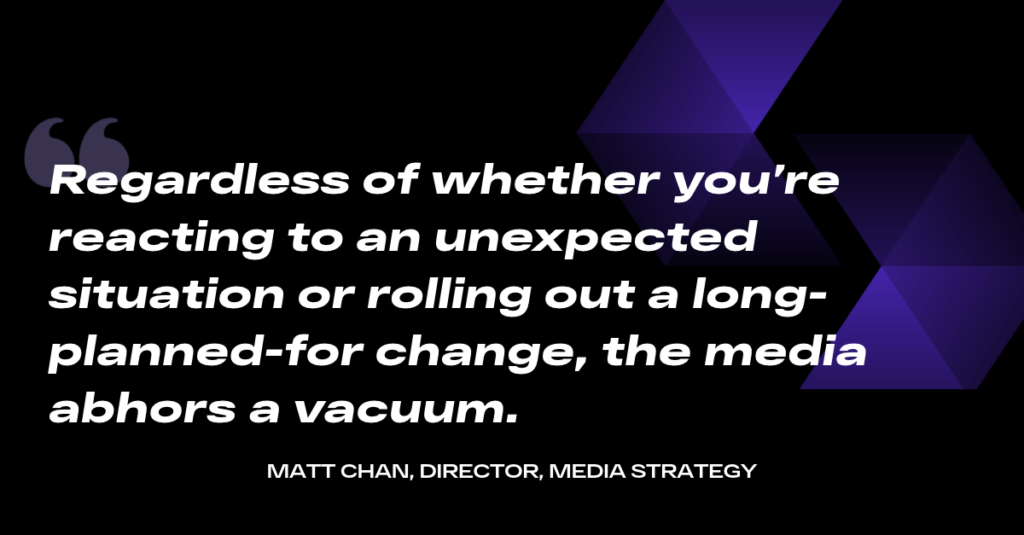
Regardless of whether you’re reacting to an unexpected situation or rolling out a long-planned-for change, the media abhors a vacuum. Communicate often, with clarity, and with confidence. Project calm and stability. Otherwise, you might find a crisis quickly snowballs.
Uncertainty is the biggest threat to a business’s prospects. A succession plan keeps investors and employees confident when a leader leaves, and it limits fallout like a lower share price and staff churn.
Concrete answers to the key questions: who is next in line, when they’re likely to start, and what they’ll bring to the role.
DataBank announced in May that its CEO, Raul Martynek, would step down at the end of the year, and it named his successor, CFO Kevin Ooley, at the same time. That gave stakeholders months to absorb the change.
Have a contingency plan ready. If you can’t yet say who is taking over, communicate often, clearly and calmly so speculation doesn’t fill the gap.