
AI in Financial Services: Can Tech Companies Overcome the Trust Deficit?

Author
John Cook
Leadership
11.05.2026


See how we tackle today’s biggest PR and marketing challenges.
 Building brand awarenessChanging brand perceptionCreating a new categoryDeveloping a brand strategyEnter new marketsGaining market shareGenerating leadsLaunching a new offeringMeasuring a comms programReddit strategy & community amplificationRepositioning a brandAI Visibility & Search Discovery (AEO/GEO)

Discover the industries we serve – and why we’re so passionate about them. From B2B SaaS to consumer health and wellness, we have the expertise to drive ROI for your PR and marketing spend.

Check out our comprehensive range of services and how we do things differently.
Awards Program & Speakers BureausBrand StrategyConsumer Reviews ProgramContent CreationContent & Coverage AmplificationCorporate CommunicationEarned Media & StorytellingExecutive VisibilityGlobal Campaign CoordinationIntegrated MarketingInfluencer RelationsMeasurement, Insights, & AnalyticsPublic AffairsSocial MediaStakeholder EngagementStrategy Counsel
It’s a simple equation: clear insights + deep expertise + creative thinking = remarkable results. Our client case studies prove it.

Learn how SourceCode is uniquely prepared to address your specific communications goals.

John Cook
11.05.2026
With major banks banning AI agents from accessing user accounts, AI companies face an uphill battle to get into the financial sector. Focusing on trust and security can help.
AI is coming to financial services. Or is it? Evidence suggests that financial institutions look on the technology with a degree of wariness. In recent weeks, several major banks have banned AI agents from accessing customers’ bank accounts. An AI backlash seems to be growing.
Although financial institutions seem OK using AI for low stakes automation, it’s a very different story when it comes to interacting with customers’ money. In light of recent high profile cases of AI models going rogue, the level of risk is perceived as being far too great.
If something goes wrong with AI agents and customer data – or worse still their money is lost – financial institutions could quickly find themselves facing regulatory sanctions while customers leave them in droves.
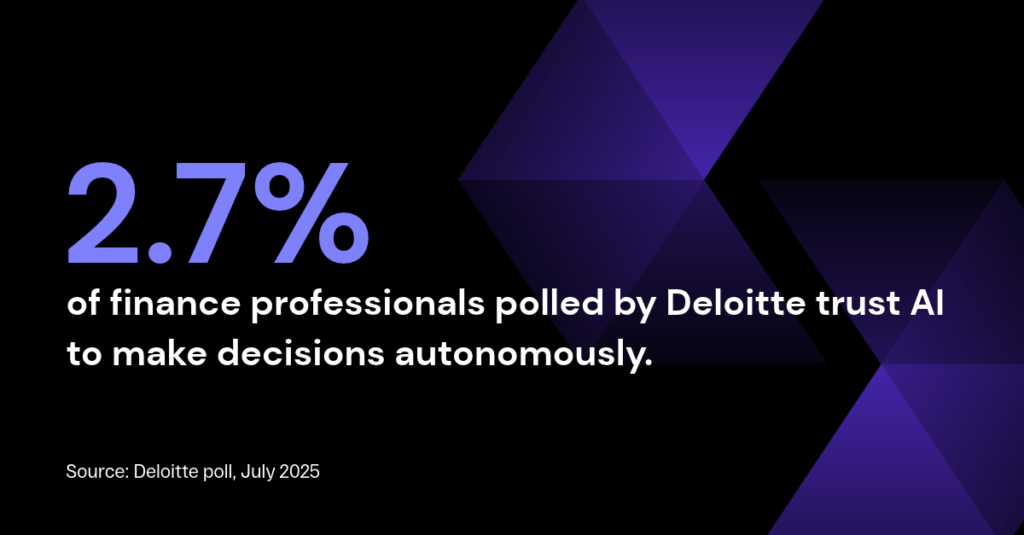
The AI trust gap is stark. Research from Deloitte reveals that just 2.7% of finance professionals trust AI to make decisions autonomously. 60% of respondents said they trust AI agents to make decisions only within a defined framework, while judgment calls should continue to be made by people.
AI businesses are learning the hard way that disruption alone is not sufficient to break into the financial sector. Rather, success means positioning away from bleeding-edge innovation and towards the watchwords of the financial sector: maturity, security, resilience, and control.
There are lessons to be learned from the first decade of fintech. 10 years ago, fintech disruptors prioritized market expansion and eye-catching tech over less flashy considerations such as risk management. As a result many saw market devaluation or consolidation. Meanwhile, incumbents weathered the wave of disruption by offering what they do best: sober, trustworthy, and stable financial services.
“AI businesses are learning the hard way that disruption alone is not sufficient to break into the financial sector.”
If AI businesses are to have a meaningful impact on the financial sector they should take note. Successful businesses will win on their ability to operate within the existing financial system and prove the safety, security, and reliability of their services. Here are my two cents on how they can achieve that:
Tech businesses selling AI services to financial institutions face an uphill struggle to earn the right to handle financial assets. If indeed that right is ever granted, it will be to companies that do the hard work of building trust. That starts with responsible business practices, but from there these practices need to be communicated proactively and substantiated with the necessary proof points. Businesses that can prove they’re mature and trustworthy might yet help to transform the world of financial services.
“Financial institutions don’t want disruption. They want innovations that have security, safety, and privacy hardwired into them.”
Banks see the risk of autonomous agents handling customer money as too high. If an agent mishandles customer data or loses money, the bank faces regulatory sanctions and customers leave.
Very little. In a Deloitte poll, just 2.7% of finance professionals said they trust AI to make decisions autonomously. About 60% trust AI agents only within a defined framework, with people making the judgment calls.
By building security, safety and privacy in from the start, showing clear human oversight of their AI, and being explicit about where autonomous agents stop and how accidental transactions are prevented.
A decade ago, many fintech disruptors put growth and eye-catching tech ahead of risk management, and many ended up devalued or consolidated. Incumbents survived by offering stable, trustworthy services.