
How Comms Can Help Secure Sales in a Risk-Averse Buying Landscape

Author
Greg Mondshein
Co-Founder
10.06.2026


See how we tackle today’s biggest PR and marketing challenges.
 Building brand awarenessChanging brand perceptionCreating a new categoryDeveloping a brand strategyEnter new marketsGaining market shareGenerating leadsLaunching a new offeringMeasuring a comms programReddit strategy & community amplificationRepositioning a brandAI Visibility & Search Discovery (AEO/GEO)
Discover the industries we serve – and why we’re so passionate about them. From B2B SaaS to consumer health and wellness, we have the expertise to drive ROI for your PR and marketing spend.

Check out our comprehensive range of services and how we do things differently.
Awards Program & Speakers BureausBrand StrategyConsumer Reviews ProgramContent CreationContent & Coverage AmplificationCorporate CommunicationEarned Media & StorytellingExecutive VisibilityGlobal Campaign CoordinationIntegrated MarketingInfluencer RelationsMeasurement, Insights, & AnalyticsPublic AffairsSocial MediaStakeholder EngagementStrategy Counsel
It’s a simple equation: clear insights + deep expertise + creative thinking = remarkable results. Our client case studies prove it.

Learn how SourceCode is uniquely prepared to address your specific communications goals.

Greg Mondshein
10.06.2026
Economic and political uncertainty is making B2B tech buyers cautious. Brands that strengthen their messaging, bolster their proof points, and tighten their narratives will build trust and outperform their peers.
First the good news. The B2B sector is resilient. Buyers are buying. According to recent research, around 46% of B2B professionals expect to make a purchase decision within 12 months.
Now the bad news. Due to prolonged economic uncertainty and political upheaval, buyers are moving with much greater caution than in the past and are more sensitive to risk. It’s still possible to sell to them, but the job’s harder than usual.
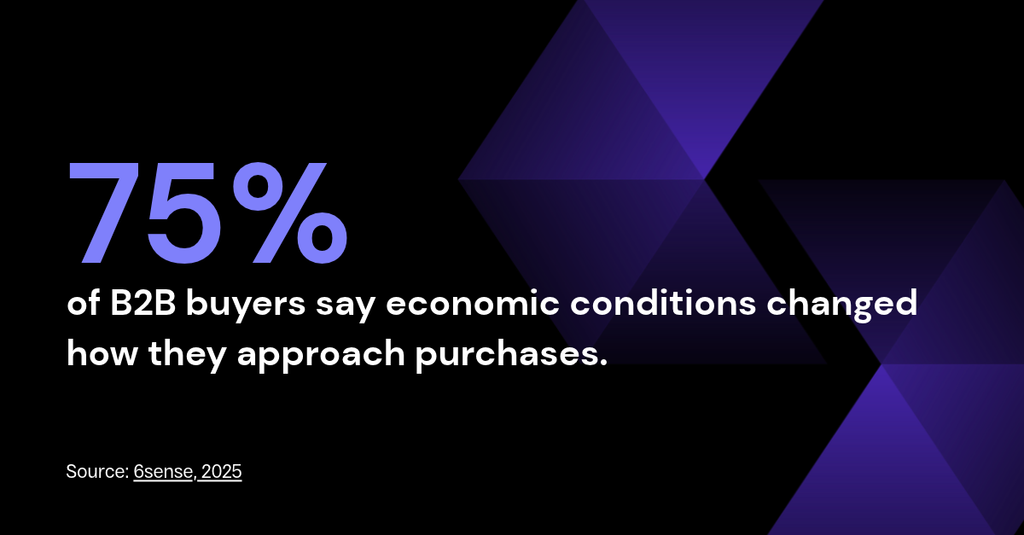
Research from 6sense reveals that 75% of buyers report that economic conditions including tariffs, inflation, and budget now affect how they approach purchases. Sixty-two percent say they’re engaging vendors earlier in the cycle specifically to de-risk their decisions and evaluate capabilities under economic challenges.
In a cautious market, your biggest competitor isn’t another company so much as buyers choosing to make do with what they already have.
Greg Mondshein, Co-Founder & Managing PArtner
The situation is a challenging one for any tech brand trying to sell to this audience. How do you communicate with confidence without coming across as being completely disconnected from reality? How do you acknowledge economic constraints and organizational risk-aversion while still pitching your company and its products?
To my mind, the answer starts with strong positioning. In a challenging environment, buyers put a premium on products and solutions that are proven and can easily be defended to the CFO. Practicality and job security are more important to them than plugging into cutting-edge innovation. They fear making a mistake more than missing out on the latest buzz tech.
However, even if you position around these factors, you still need to give your audience a reason to buy. In a cautious market, your biggest competitor isn’t another company so much as buyers choosing to make do with what they already have.
You therefore need to make doing nothing seem like an operational or financial risk. For example, instead of positioning your AI workforce management platform as “transforming the working experience through the power of advanced AI,” you could instead say “eliminate the workforce management challenges costing your business $500K every year.” Put a cost on the status quo.
The next step is to sharpen your proof points. When buyers are feeling cautious, aspirational promises or woolly messages around being the “world’s leading” won’t get you very far. Buyers need verifiable facts that help build certainty and make them more comfortable making a purchase.
Buyers need verifiable facts that help build certainty and make them more comfortable making a purchase.
Greg Mondshein, Co-Founder & Managing Partner
The key here is to be specific and granular. For instance, if your tech can save time for IT teams, detail exactly how much time is saved over what period, and what that translates to in terms of FTEs. Make your value proposition concrete. You need to give any advocate for your services as much data as possible to help them persuade their CFO and any other decision makers that you’re a safe bet.
Finally, narrative discipline is crucial. Buyers today are easily put off by shifting claims, inconsistent messaging, or ambiguity in a brand’s proposition. Conversely, if they see the same, consistent story told across channels, buyers are more likely to trust your brand and be willing to invest in your products and services.
The focus of the narrative is also key. Keep it simple with a clear value proposition backed up by those all-important proof points. The goal is to make it as easy as possible for the buyer to understand and trust the value you can bring.
Times are tough in the B2B landscape, but there’s still an opportunity to grow. The crucial shift is to understand that corporate communications isn’t just about brand-building, it’s also about reducing perceived risk and building confidence in you and your services.
Get in touch and learn how we can help your brand communicate successfully in today’s risk-averse buying landscape.
Start with positioning around what is proven and easy to defend to a CFO. Cautious buyers value practicality and job security over cutting-edge innovation, and they fear making a mistake more than missing out.
Usually not another vendor. It is the buyer deciding to make do with what they already have, so your messaging has to show that doing nothing carries its own operational or financial cost.
Specific, verifiable detail. If your product saves IT teams time, say how much, over what period, and what that equals in staff, so your internal champion has numbers to take to finance.
Shifting claims and inconsistent messaging put cautious buyers off. When they see the same clear story across every channel, backed by proof points, they are more likely to trust the brand and invest.