
Building a media strategy for an AI-first audience

Author
Kristen Stippich
Leadership
08.17.2026


See how we tackle today’s biggest PR and marketing challenges.
 Building brand awarenessChanging brand perceptionCreating a new categoryDeveloping a brand strategyEnter new marketsGaining market shareGenerating leadsLaunching a new offeringMeasuring a comms programReddit strategy & community amplificationRepositioning a brandAI Visibility & Search Discovery (AEO/GEO)
Discover the industries we serve – and why we’re so passionate about them. From B2B SaaS to consumer health and wellness, we have the expertise to drive ROI for your PR and marketing spend.

Check out our comprehensive range of services and how we do things differently.
Awards Program & Speakers BureausBrand StrategyConsumer Reviews ProgramContent CreationContent & Coverage AmplificationCorporate CommunicationEarned Media & StorytellingExecutive VisibilityGlobal Campaign CoordinationIntegrated MarketingInfluencer RelationsMeasurement, Insights, & AnalyticsPublic AffairsSocial MediaStakeholder EngagementStrategy Counsel
It’s a simple equation: clear insights + deep expertise + creative thinking = remarkable results. Our client case studies prove it.

Learn how SourceCode is uniquely prepared to address your specific communications goals.

Kristen Stippich
08.17.2026
All PR professionals know that good communications have the customer’s needs front and center. The best also realize that you will have more success if you also tailor your campaign messages to meet the needs of specific journalists and media outlets. These two audiences have been the foundation of good corporate communications for as long as PR has been a profession.
Thanks to AI, however, things are changing. More often than not, the first audience that a brand needs to win over is neither a customer nor a journalist. In fact, they’re not even human.
According to Forrester, 94% of B2B buyers report using AI in their decision-making process, while twice as many buyers named generative AI or conversational search as a more meaningful or important source of information than any other source. Marketers therefore should view AI search tools as their first audience. Winning the human conversation and winning the AI answer are two sides of the same coin.Brands that think in term

Your business pitch is dead in the water before it’s even had a chance to leave harbor.
The best way to show up in AI search summaries is through earned media, which accounts for 84% of all AI citations. But not all earned media is equal. When it comes to industry-specific topics, AI models prefer authoritative, third-party subject matter experts above owned brand content. Or to put it another way: AI models favor brands that are cited in trade and vertical publications.
Major tier-one coverage is great. We all love it. But without these trade and vertical hits, your brand is all but invisible when AI models search for category leaders. That in turn means it’s highly unlikely that you’ll show up on your buyer’s shortlist. Your business pitch is dead in the water before it’s even had a chance to leave harbor.
That said, focusing on an AI-first audience actually helps brands secure tier-one coverage. This is because it involves working closely with trade reporters, most of whom ultimately end up working at top-tier national or business publications. Cultivating them early means a big payoff down the line.
Savvy communicators therefore aim for a layered media mix that builds authority along the way. Tier-one coverage builds brand awareness and executive authority. Trade and specialist coverage provides the technical depth that feeds content intelligence and third-party authority and validation while boosting AI discoverability. A successful communications campaign is balanced and well rounded, reaching all audiences wherever they may be.
Brands that think in terms of measurable business outcomes rather than tactical media tiers will always outperform their peers.
The key to success in communications is in fact no different to any element of business insofar as the solution needs to relate to the business requirement. Brands that think in terms of measurable business outcomes rather than tactical media tiers will always outperform their peers.
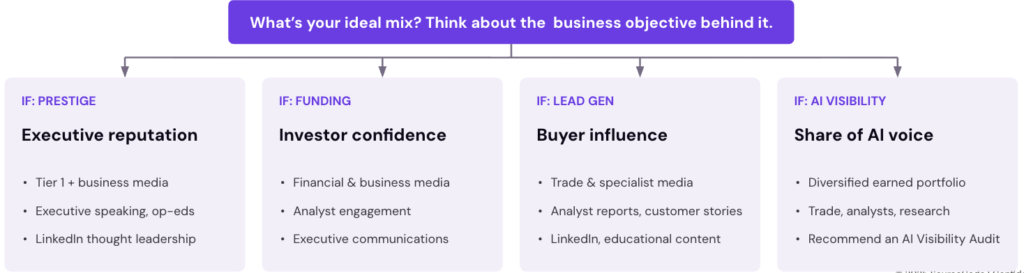
Before you create a media strategy, ask yourself what you are trying to achieve. If, for example, you want to build executive reputation and prestige then this is where tier-one national media, business publications, and executive speaking engagements really come into play.
However, if the aim is to support investor confidence, then the media mix will be different, with much more of a focus on financial media, business media, and industry analysts. Similarly, if you’re looking to grow your lead pipeline and influence buyers, then you should heavily index toward trade publications, LinkedIn, customer stories, and specialist industry media, which provide stronger validation among technical practitioners and evaluators. If your goal is simply to show up in AEO, then the priority is a diversified portfolio of communications.
Brands can prioritize their media lists by creating an authority matrix that visualizes which channels of communication carry the most weight according to the industry and the business outcome you’re trying to achieve (translated into who you are trying to influence or reach). A generalized B2B snapshot based on a target audience would look something like this:
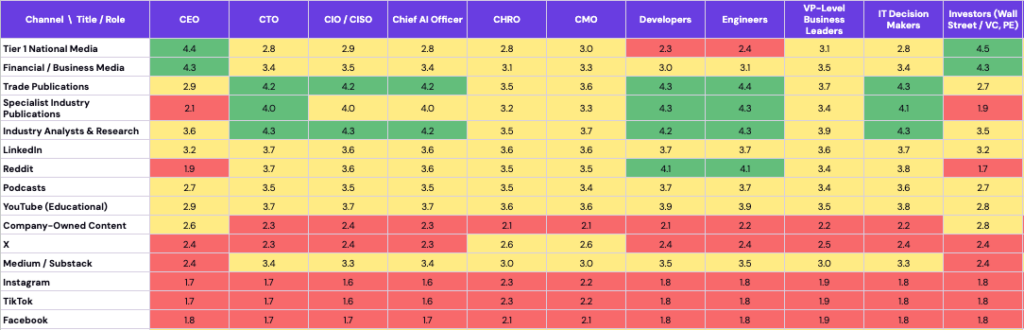
The matrix illustrates how different channels contribute to authority, providing a snapshot of how different channels serve different purposes, and giving an opportunity for brands to incorporate how AI decides whether to cite a brand.
No single channel supports every objective. The process of mapping your media provides visual evidence of the role various media mixes play depending on your goals, and enables you to create the optimum balance each time.
The process of heatmapping your media provides visual evidence of the role various media mixes play depending on your goals…
When it comes down to actually shifting the dial on business outcomes, successful brands create tailored media mixes to meet the needs of each specific goal. These organizations don’t just benefit from hero coverage. They increase awareness, improve AEO, generate leads, and drive sales in a way that’s impactful and measurable.
SourceCode Communications can help you heatmap and prioritize your media to meet your business objectives. Get in touch to learn more.
For a growing share of B2B buyers, an AI answer or a generative search result is now a more influential source of information than a journalist, a vendor website, or a salesperson. That makes AI search tools a second, equally important audience alongside human readers.
Earned media, coverage a brand didn’t pay for or write itself, is what AI models cite most. Within that, AI models tend to favor brands mentioned by third-party experts in trade and vertical publications over brand-owned content.
A layered strategy combines tier-one national and business coverage, which builds broad awareness and executive authority, with trade and specialist coverage, which builds the technical depth and third-party validation that AI models weigh heavily.
Start with the business outcome you’re after. Executive reputation points toward tier-one media and speaking engagements. Investor confidence points toward financial and analyst coverage. Lead generation points toward trade press and customer stories. Showing up in AI answers points toward a diversified spread across all of them.
A media heatmap, or authority matrix, visualizes which channels carry the most weight for a given audience and business goal, so a brand can see at a glance where to focus instead of guessing.