
Your SEO Strategy Wasn’t Built for a World Where Google Isn’t the Front Door

Author
Georg Loewen
05.12.2026


See how we tackle today’s biggest PR and marketing challenges.
 Building brand awarenessChanging brand perceptionCreating a new categoryDeveloping a brand strategyEnter new marketsGaining market shareGenerating leadsLaunching a new offeringMeasuring a comms programReddit strategy & community amplificationRepositioning a brandAI Visibility & Search Discovery (AEO/GEO)
Discover the industries we serve – and why we’re so passionate about them. From B2B SaaS to consumer health and wellness, we have the expertise to drive ROI for your PR and marketing spend.

Check out our comprehensive range of services and how we do things differently.
Awards Program & Speakers BureausBrand StrategyConsumer Reviews ProgramContent CreationContent & Coverage AmplificationCorporate CommunicationEarned Media & StorytellingExecutive VisibilityGlobal Campaign CoordinationIntegrated MarketingInfluencer RelationsMeasurement, Insights, & AnalyticsPublic AffairsSocial MediaStakeholder EngagementStrategy Counsel
It’s a simple equation: clear insights + deep expertise + creative thinking = remarkable results. Our client case studies prove it.

Learn how SourceCode is uniquely prepared to address your specific communications goals.

Georg Loewen
05.12.2026
But before you panic-buy a GEO platform, let’s talk about what’s actually happening.
Here’s a fun game. Open LinkedIn, scroll for ninety seconds, and count how many posts you see declaring that SEO is dead, AI has eaten search, and if you’re not “optimizing for ChatGPT” by next quarter you might as well close the doors and start an alpaca farm.
Now count how many of those posts are written by someone who happens to sell an AEO platform, a GEO tool, or a $5,000 “AI visibility audit.” I’ll wait.
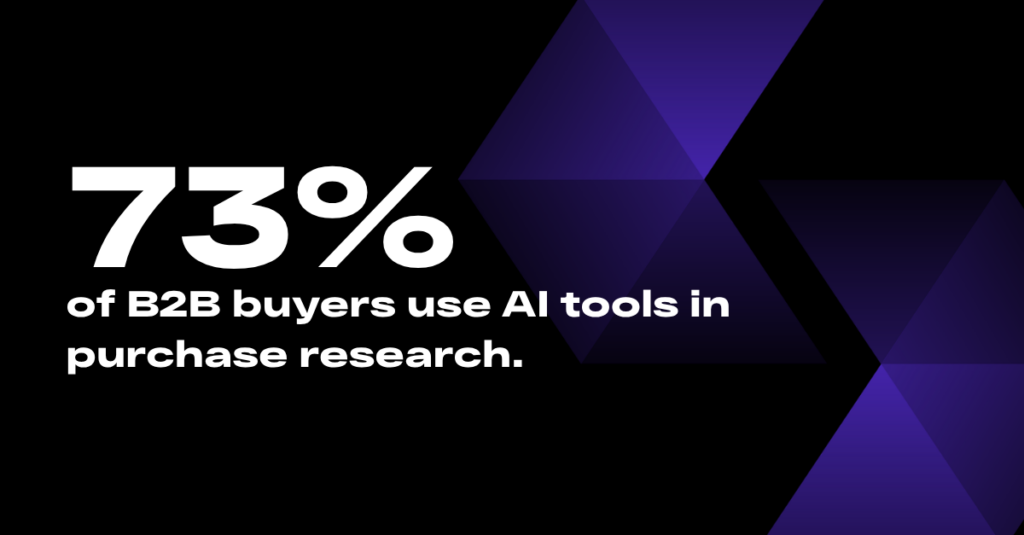
The AI search conversation has reached peak hysteria, and it’s getting harder by the day to figure out what’s actually happening versus what’s being sold to you by people with a commercial interest in your panic. Gartner predicts a 25% drop in traditional search engine volume by 2026. Seer Interactive’s analysis of 3,119 queries across 42 organizations found organic CTR dropped 61% on queries where AI Overviews appear. Pew Research tracked actual browsing behavior for 900 adults across nearly 69,000 Google queries and confirmed users click links 8% of the time when an AI summary appears, versus 15% without one. A recent synthesis by SEO vendor Loganix, pulling from six independent studies, found 73% of B2B buyers now use AI tools like ChatGPT and Perplexity in their research process. The numbers all point in the same direction, and the direction looks terrifying.
Except the other half of the data is telling a very different story.Graphite and Similarweb analyzed the top 40,000 US websites and found organic search traffic from Google is down just 2.5% year-over-year – not 25%.Total search usage, combining traditional and AI, has actually increased by 26% globally since ChatGPT launched.WordStream’s 2026 Small Business Website Trends Report found 60% of businesses hadn’t seen any impact to their traffic from AI search yet. And Eli Schwartz at ProductLedSEO, working from one of the largest independent datasets available – over 260 billion clickstream sessions – found that users aren’t replacing Google with ChatGPT. They’re using both, in parallel, for different things.
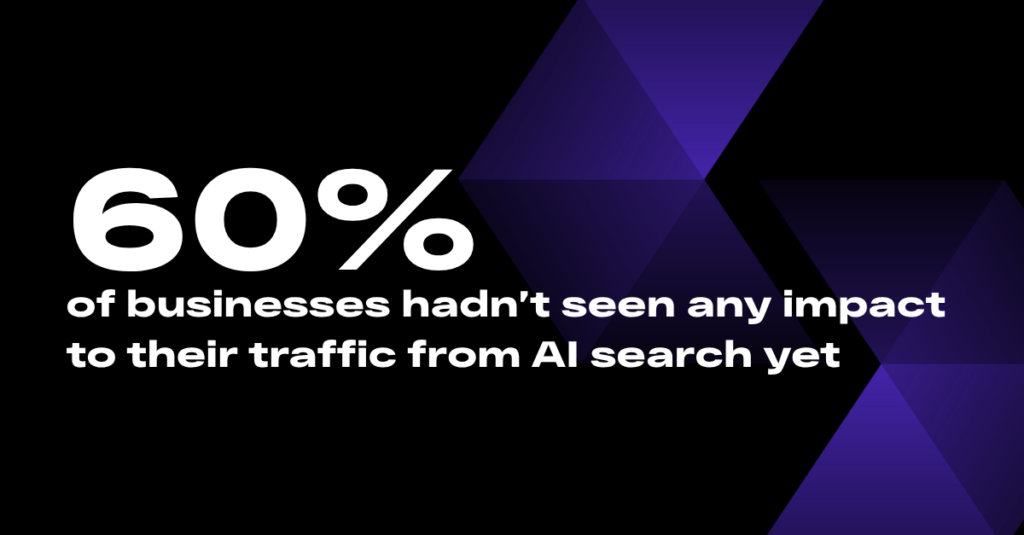
Source: WordStream by Localiq, 9 SEO Trends Shaping Search in 2026
So which is it? Is AI search an extinction-level event for SEO or is it overhyped vendor noise dressed up as strategy?
The honest answer: it’s neither, and the people trying to sell you one or the other are missing the point entirely. Something real is happening. It’s just not what most of the headlines say it is. And the most important implication has almost nothing to do with technical SEO.
Let’s unpack it.
Before we get into the data, let’s name the dynamic that’s making this conversation so hard to navigate. A lot of the loudest voices on AI search are funded by the narrative that AI search is a crisis. The venture-backed GEO platform economy is now large enough that analysts are tracking 20+ dedicated AI visibility tools with an industry-average price point around $337 per month – a number that is itself aggregated by GEO vendors, for what it’s worth. Every single one of those platforms has a fundraising deck that depends on marketers believing their existing SEO programs are obsolete.
This isn’t a conspiracy theory. It’s just how B2B marketing categories get built. Somebody coins a three-letter acronym (AEO, GEO, LLMO, pick your flavor), somebody else raises a Series A on the back of it, and then the content marketing machine spins up to manufacture the urgency required to close deals. The cycle is familiar. We’ve seen it with CDPs, ABM platforms, intent data, and about fourteen different flavors of “revenue intelligence.”
Source: WordStream by Localiq, 9 SEO Trends Shaping Search in 2026
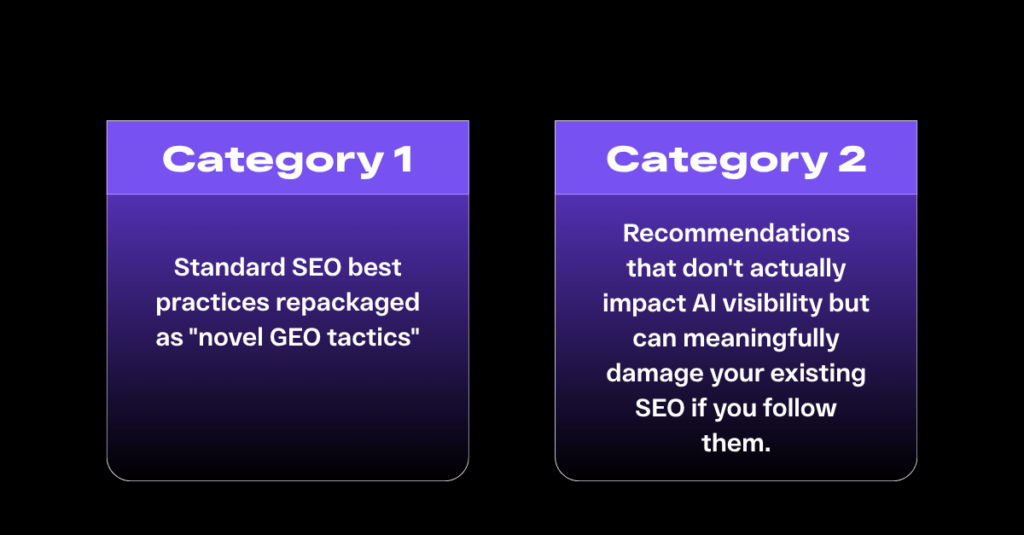
WordStream’s Tom Demers put it bluntly: most current GEO advice falls into two categories. Category one is standard SEO best practices repackaged as “novel GEO tactics” – harmless but unoriginal. Category two is recommendations that don’t actually impact AI visibility but can meaningfully damage your existing SEO if you follow them. The “create an AI-friendly copy of your site” advice currently making the rounds falls into category two, for what it’s worth.
This is the backdrop you need to keep in mind as we look at the data. A lot of it is directionally accurate. Some of it is useful. Almost all of it is produced by people who benefit from you feeling behind.
Let’s take the four most-cited stats in the panic narrative and actually read them.
“AI Overviews caused a 61% drop in organic CTR.” This comes from Seer Interactive’s September 2025 analysis, and the research itself is solid. They tracked 3,119 queries across 42 client organizations over 15 months. Organic CTR on queries where AI Overviews appeared fell from 1.76% to 0.61%. That’s real.
What’s less discussed: Seer’s sample specifically tracked informational and educational queries – the query type most vulnerable to AI Overviews. Commercial and transactional queries, where the actual money is made, are far less affected. The CTR decline is genuinely dramatic for “how does X work” queries. For “buy X” or “X vendor comparison” queries, the impact is much smaller.
Seer’s own data also found something the panic headlines skip: brands cited in AI Overviews saw a 35% higher organic CTR and 91% higher paid CTR than non-cited brands on the same queries. The clicks aren’t disappearing. They’re consolidating around the brands that AI engines trust enough to reference. Being cited is the new ranking. That matters, and we’ll come back to it.
“Only 8% of users click a link when an AI summary appears.” This is from Pew Research’s July 2025 study, which tracked actual browsing behavior for 900 US adults across 68,879 Google queries. Methodologically, it’s the most rigorous independent study we have. The finding is real: CTR drops from 15% without an AI summary to 8% with one.
What you won’t see in most citations: Google publicly confirmed it processes more than 5 trillion searches annually. Pew’s sample is 68,000 queries from 900 people over one month. That’s a perfectly valid behavioral study, but extrapolating from it to “AI has killed search” is the equivalent of tasting one oyster and canceling the entire ocean. The behavioral pattern aligns with other studies, but the magnitude of the industry-wide claim is much bigger than what this specific dataset supports.
Source: Loganix, 2026 B2B AI Buying Behavior Analysis 2026
“Gartner predicts 25% of traditional search volume will shift to AI by 2026.” This is probably the most-cited forecast in the entire AI search conversation. It comes from a February 2024 Gartner press release based on analyst Alan Antin’s research. It’s also a prediction – a forward-looking analyst forecast, not a measurement of actual behavior. Search Engine Land’s Tom Demers noted at the time that “a prediction… is just a guess. Gartner’s predictions are typically informed, but they’re still best guesses”. Treating this one as settled fact is a choice, and it’s a choice a lot of vendors have made because it’s extremely good for business.
“73% of B2B buyers use AI tools in purchase research.” This comes from the Loganix 2026 B2B AI Buying Behavior Analysis, which is a synthesis of six underlying studies. The headline figure itself is from an Averi citation analysis. Loganix is an SEO vendor. Averi is an AI marketing platform. The synthesis is useful, but you’re reading a vendor report that cites vendor reports. Directionally, the trend is real – AI tools are genuinely showing up in B2B research workflows. Specifically, “73% of B2B buyers” is the kind of number that sounds precise but has methodological assumptions baked into it that would probably make you uncomfortable if you dug in.
None of this is to say the stats are wrong. They’re mostly directionally correct. The point is that the headline version of each of them has been flattened into something much scarier than the underlying research actually says. When you read these stats in a LinkedIn post or a vendor whitepaper, you’re getting the panic-optimized version.
The most important analysis you’ll read on this topic wasn’t funded by a GEO vendor. It was published by Graphite in partnership with Similarweb, and it looks at organic search traffic to the top 40,000 US websites comparing February–December 2024 against January–November 2025.
The finding: organic traffic from Google is down 2.5% year-over-year. Not 25%. Not 50%. 2.5%.
The decline isn’t even evenly distributed. The biggest and smallest sites in the dataset actually saw traffic increase. The decline is concentrated in mid-sized sites (rank 100 to 10,000), and even there it’s measured in single digits. News, health, cooking, and entertainment got hit hardest, which tracks with the AI Overview informational-query concentration. Commerce, shopping, and marketplaces actually grew.
Graphite’s follow-up analysis makes an even bigger point: total search volume – traditional search plus AI search combined – is up 26% globally since ChatGPT launched. The narrative that AI is cannibalizing search assumes a fixed pie. The pie isn’t fixed. It’s growing. Traditional search volume has stayed roughly flat while AI search has added an entirely new layer of query behavior on top.
This aligns with what Eli Schwartz found when he analyzed over 260 billion clickstream sessions – one of the largest independent datasets on this topic. Users aren’t picking Google or ChatGPT. They’re running parallel journeys. Someone researching a project management tool might start with ChatGPT for a category primer, Google specific products, check Reddit for real user experiences, go back to ChatGPT for a comparison, then Google pricing. There’s no cannibalization happening. There’s fragmentation.
Orbit Media’s 2026 AI-Search Adoption Survey adds another useful counterpoint: ChatGPT regular usage held flat at 36% year-over-year, and the share of respondents who said they “usually use search” for research actually grew from 22% to 29%. AI adoption is real, but it’s not the exponential accelerant the panic narrative suggests.
And most tellingly, a LinkedIn poll by Lily Ray with 1,316 responses from SEOs and marketers who actually track this data found that 70% of websites get less than 2% of their traffic from ChatGPT. 38% get less than half a percent.Conductor’s own 2026 AEO/GEO Benchmarks – and Conductor sells an AEO platform, so take this with a grain of salt in the direction that helps them – put AI referral traffic at 1.08% of total website traffic across 10 major industries.
To summarize the unfashionable truth: for most businesses, AI search is currently a rounding error on their traffic reports. Not zero. Not irrelevant. But not a crisis either.
All of which makes it tempting to conclude that AI search is overhyped and you can safely ignore it. That conclusion is also wrong. Something real is happening. It’s just happening upstream of where most marketers are looking.
The top of the funnel is moving. The clearest finding in Similarweb’s 2026 Generative AI Brand Visibility Report is that AI tools have taken over the discovery stage of the purchase journey. 35% of US consumers now use AI at the product discovery stage, compared to just 13.6% using traditional search. That’s a 2:1 advantage for AI at the very beginning of the buyer journey. Search still wins at the transaction stage, but by the time a buyer reaches a search engine, their shortlist is already set.
For B2B, the implication is brutal: if your brand isn’t appearing in ChatGPT and Perplexity responses when a buyer asks “what are the best tools for X,” you’re not on the shortlist. You might never have known you were eliminated, because the elimination happened in a conversation you couldn’t see, with an AI that doesn’t send you analytics.
The citation economy is real, even if the traffic is small. Here’s the counterintuitive part. Traffic from AI search is small, but the brand exposure happening through AI search is not. EMARKETER, citing Similarweb’s 2026 GenAI Brand Visibility Index, reported that Reuters and The Guardian receive less than 1% of their referral traffic from AI platforms despite being among the most frequently cited sources on those platforms. The citations are shaping perception without generating clicks.The same EMARKETER piece quoted Washington Post CRO Karl Wells saying AI-referred visitors convert to paid subscriptions at 4 to 5 times the rate of traditional search traffic.
In other words: the people clicking through from AI search are closer to the decision. The people seeing your brand cited without clicking through are being influenced in ways your Google Analytics dashboard will never show you.
Brand authority has become a direct discoverability input. This is the shift that matters most and is discussed least. Ahrefs analyzed 75,000 brands and found that branded web mentions show a 0.664 Spearman correlation with AI Overview visibility – more than three times stronger than the 0.218 correlation for backlinks. Content depth, freshness, and structured data all matter. But the dominant signal is brand mentions across trusted third-party sources. In a follow-up study published in December 2025, Ahrefs confirmed the same pattern across ChatGPT, AI Mode, and AI Overviews – branded web mentions topped the correlation table in every single platform.
Translation: your PR program is now an SEO input. Every media placement, every byline, every podcast appearance, every speaking slot, every industry forum mention is a signal that feeds into how AI engines evaluate whether your brand is citation-worthy. This is the “earned media is now performance marketing” conversation that integrated agencies have been having for a decade, except now there’s a measurement attached to it.
The playbook isn’t technical SEO. It’s integrated communications. Which brings us to the thing most companies are missing.
Here’s what this looks like practically. None of this is revolutionary. Some of it is genuinely important.
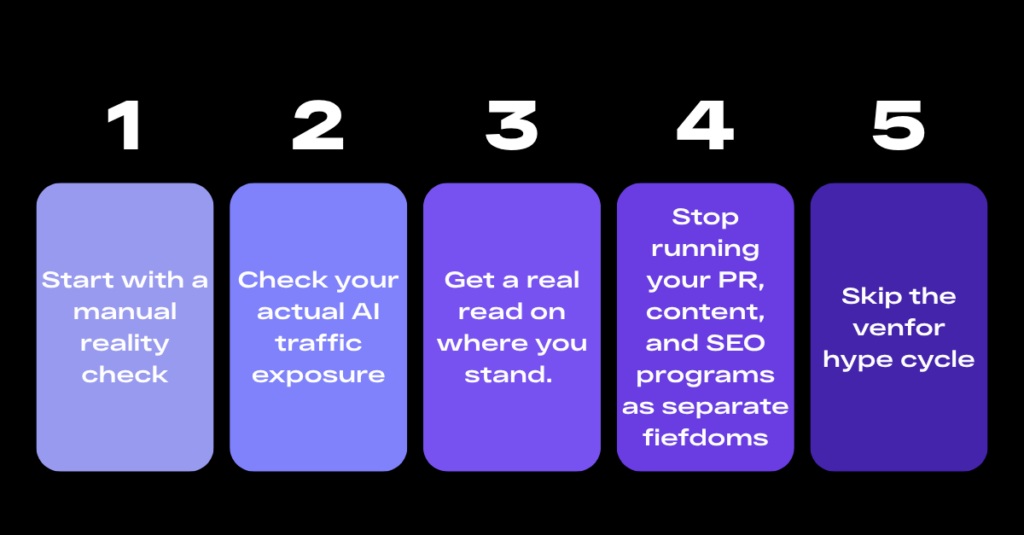
1. Start with a manual reality check. Before anyone invests in tooling, open ChatGPT, Perplexity, and Google AI Mode and ask five of the buying questions your prospects ask. Note who gets cited and whether you appear. This won’t give you a strategy, but it will tell you whether you have a problem. For a lot of companies, this twenty-minute exercise is the moment the abstract AI search conversation gets uncomfortably concrete.
2. Check your actual AI traffic exposure. Look at your referral sources for chatgpt.com, perplexity.ai, claude.ai, copilot.microsoft.com. If you’re getting less than 1% of traffic from these sources, you’re at the industry average. Don’t panic. But do start monitoring – because this is the number that will tell you when the shift starts affecting your business, not the headlines.
3. Get a real read on where you stand. A manual check tells you if you have a problem. It doesn’t tell you why, how wide the gap is versus competitors, which of your content assets are actually working in AI environments, or what to prioritize. That’s the work. At SourceCode, when we run an AEO audit for a client, we’re looking at query coverage across platforms, competitor citation patterns, content extractability, the brand authority signals that AI engines actually weight, and the gaps between your earned media footprint and your search visibility. A $400/month dashboard tool tracks prompts. An audit tells you what to do about them.
4. Stop running your PR, content, and SEO programs as separate fiefdoms. This is the biggest lever most B2B companies still haven’t pulled. If your PR agency reports to comms, your SEO agency reports to demand gen, and they’ve never been in a room together, you’re leaving your most valuable discoverability signals on the floor. The brands that win in AI search aren’t the ones with the best technical SEO. They’re the ones whose earned, owned, and paid programs reinforce each other instead of running in parallel.
5. Skip the vendor hype cycle. The GEO platform economy is crowded and the metrics are inconsistent. Most of what’s being sold as revolutionary is SEO best practice in a new wrapper. A tool can tell you where your brand shows up. It can’t tell you why your integrated strategy isn’t producing the authority signals AI engines reward, and it definitely can’t rebuild the connection between your PR and search programs for you. Start with strategy. Buy the tool when you know what you’re measuring and why.
AI search isn’t killing SEO. AI search isn’t going to be the biggest thing to happen to marketing since the iPhone. The truth, as usual, is in the boring middle: a meaningful structural shift is happening in how buyers discover and evaluate solutions, the top of the funnel is moving faster than the middle and bottom, and the companies that win are going to be the ones that connect their earned, owned, and paid programs to show up consistently across every surface where their buyers are looking.
Which is, inconveniently, exactly what integrated marketing has been saying for years. The difference now is that the cost of not doing it is finally measurable.
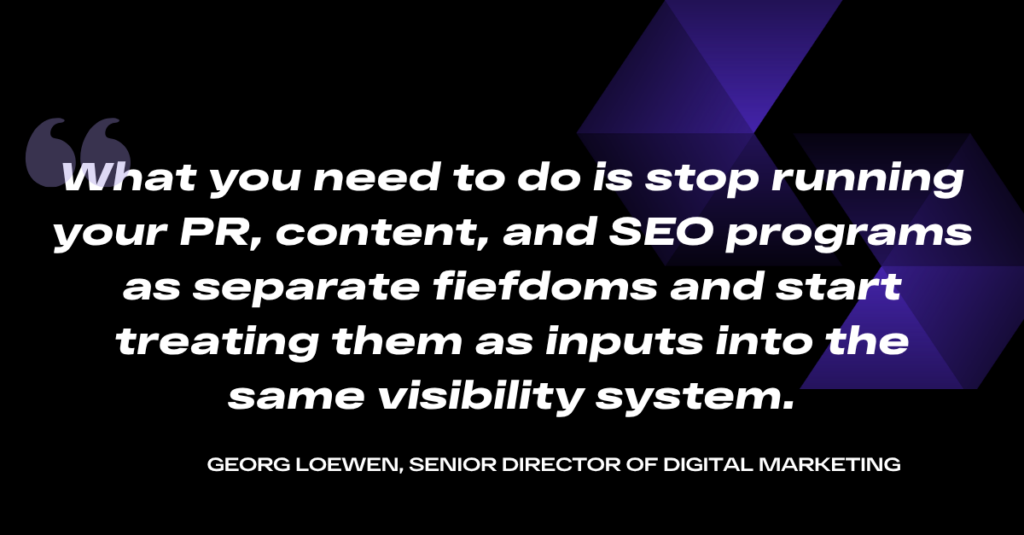
If AI search were truly an apocalypse, you’d need to blow up your marketing org and start over. It isn’t. What you need to do is stop running your PR, content, and SEO programs as separate fiefdoms and start treating them as inputs into the same visibility system.
That’s the real takeaway. The panic is overblown. The complacency is dangerous. The opportunity is to do what most companies still aren’t doing, which is to connect the dots across channels that actually reinforce each other in an AI-mediated world.
___
Looking at your own AI search visibility and wondering where to start? Let’s talk– no revolutionary paradigm shifts required.